7-Step Deformation Prevention Processing Process | SG MOLD 'Mold Base' System
2026-02-26 09:58:23


1. Why is 'deformation' a problem in mold base production?
The mold base is a structure that is the basis for mold manufacturing, and its floor plan, parallelity, and dimensional precision directly affect the performance of the entire mold.
However, the mold base may have a "post-processing deformation" phenomenon in which the shape is distorted or the dimensions are out of alignment due to residual stress, thermal deformation, and cutting stress during processing.
Even these minor deformations can cause errors in subsequent assembly and lead to problems such as shorter mold life and higher mold failure rates.
To prevent this, SG MOLD is systematically applying 'deformation control technology' to the processing process itself.
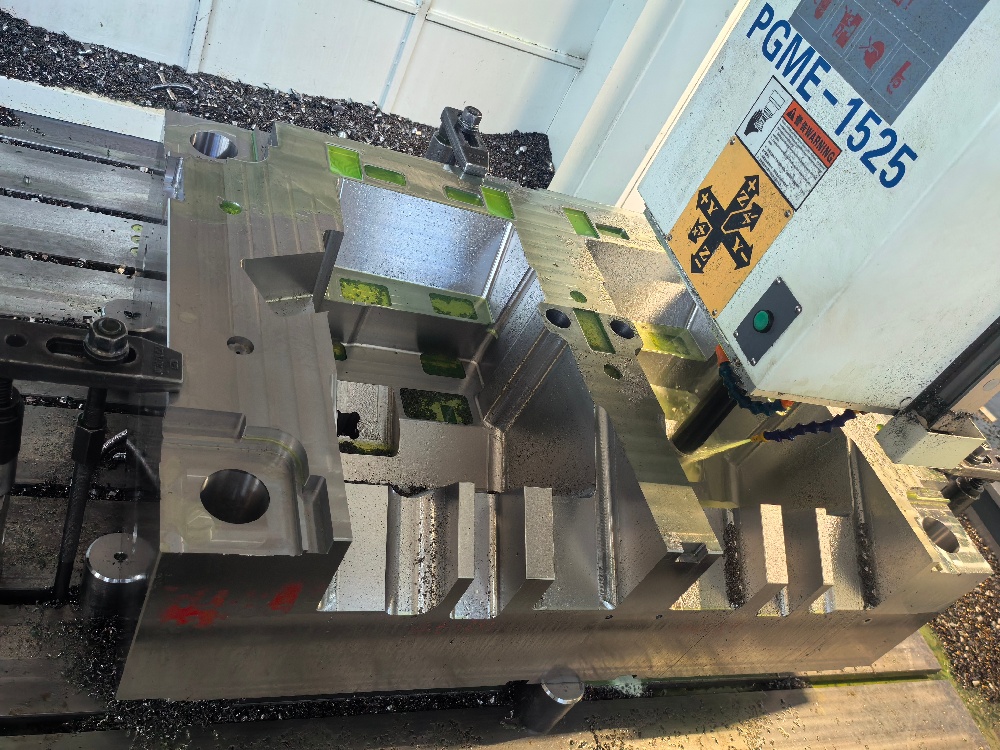
2. SG MOLD's 7-Step Deformation Prevention Processing Process
The mold base processing applied by SG MOLD is carried out through the following seven-step procedure, each of which aims to secure precision, repeatability, and structural stability.
2.1 Step 1 – Primary milling (extended dimensions secured)
The metal block in the raw material state is first milled to organize the surface, leaving a certain amount of processing margin.
This step is a proactive action that takes into account stress deformation that may occur during subsequent processes.
2.2 Step 2 – Rough machining (internal stress distribution)
The first structural processing is carried out to create basic shapes such as hole processing and shape cutting.
In this process, some of the metal's internal stress is dispersed and the initial shape stabilization is promoted.
2.3 Step 3 – Heat treatment or annealing (stress removal)
Heat the material at high temperatures to remove residual stress after processing, or stabilize the crystal structure through an annealing process.
This is a key step in minimizing deformation of the product even during long-term use after processing.
2.4 Step 4 – Flat milling (with precise floor plan)
Precision plane processing of the stress-removed block to secure the full floor plan of the upper and lower plates.
At this time, fine distortion is corrected through high-precision milling facilities.
2.5 Step 5 – Intermediate machining (Detailed shape arrangement)
After all processing standards are set, detailed shape processing such as insertion holes, guide holes, and screw holes of each part is performed.
This process is the final preparation step for subsequent precision processing.
2.6 Step 6 – Precision drawing (reflects customer design)
Accurate dimensional processing and detailed finishing within mechanical tolerances are carried out according to customer drawing standards.
Parts requiring ±0.01mm precision can also be dealt with without problems.
2.7 Step 7 – Precision grinding and secondary deformation calibration
Finally, the surface is finished precisely by a grinding machine, and after a second strain correction, all dimensions and parallelism are reconfirmed.
This process prevents errors after installation.
3. Why SG MOLD's "Mold Base Without Deformation" is special
In general processing methods, there are many cases where only three to four steps are taken.
However, SGMOLD has a manufacturing system that prioritizes stress control and dimensional precision throughout the entire process, taking into account both productivity and quality stability.
In addition, all processing is managed by an ERP-based history tracking system and is designed to store production records and quality data for each product for immediate cause analysis and improvement in the event of a problem.
4. Closing Information
It's not just a mold base that fits the shape,
If you're looking for a high-quality mold base that doesn't twist even when using it for a long time,
SG MOLD is the answer.
Contact Us: +86-19952218899
Home page: https://www.shuaigangmj.cn
Email: sd@sg-mold.com
Q1. Why do you need a seven-step processing process?
A1. By controlling stress and thermal deformation step by step, minimize deformation of the mold base and maintain assembly precision.
Q2. How is ±0.01mm precision realized?
A2. High-precision manufacturing is possible through heat treatment, precision plane milling, and secondary grinding processes.
Q3. What are the advantages of ERP-based production management?
A3. By tracking production history and quality data across the company, we can respond immediately to quality issues.